Think you know Dracula? Think again. Countess Dracula sinks its fangs into Bram Stoker’s legend and resurrects it as a darkly funny, fiercely feminist tale of power, ageing, and rebirth. Not your usual gothic romp, the 60 minute play exposes how society sidelines women as they age, turning their bodies and desires into something to be hidden—or feared—while reclaiming the agency and rage that culture tries to erase. Drawing on the dark allure of the myth of Dracula, the play imagines the Countess reclaiming her waning fire by siphoning the very force of youthful masculinity. A blood-soaked, lipstick smeared rebellion against the patriarchy, I was hooked instantly. After all, there’s something powerful about watching a woman that refuses to fade. Showing at New Camden Theatre, its two person cast consists of Joanna Holden and Jack Kelly.
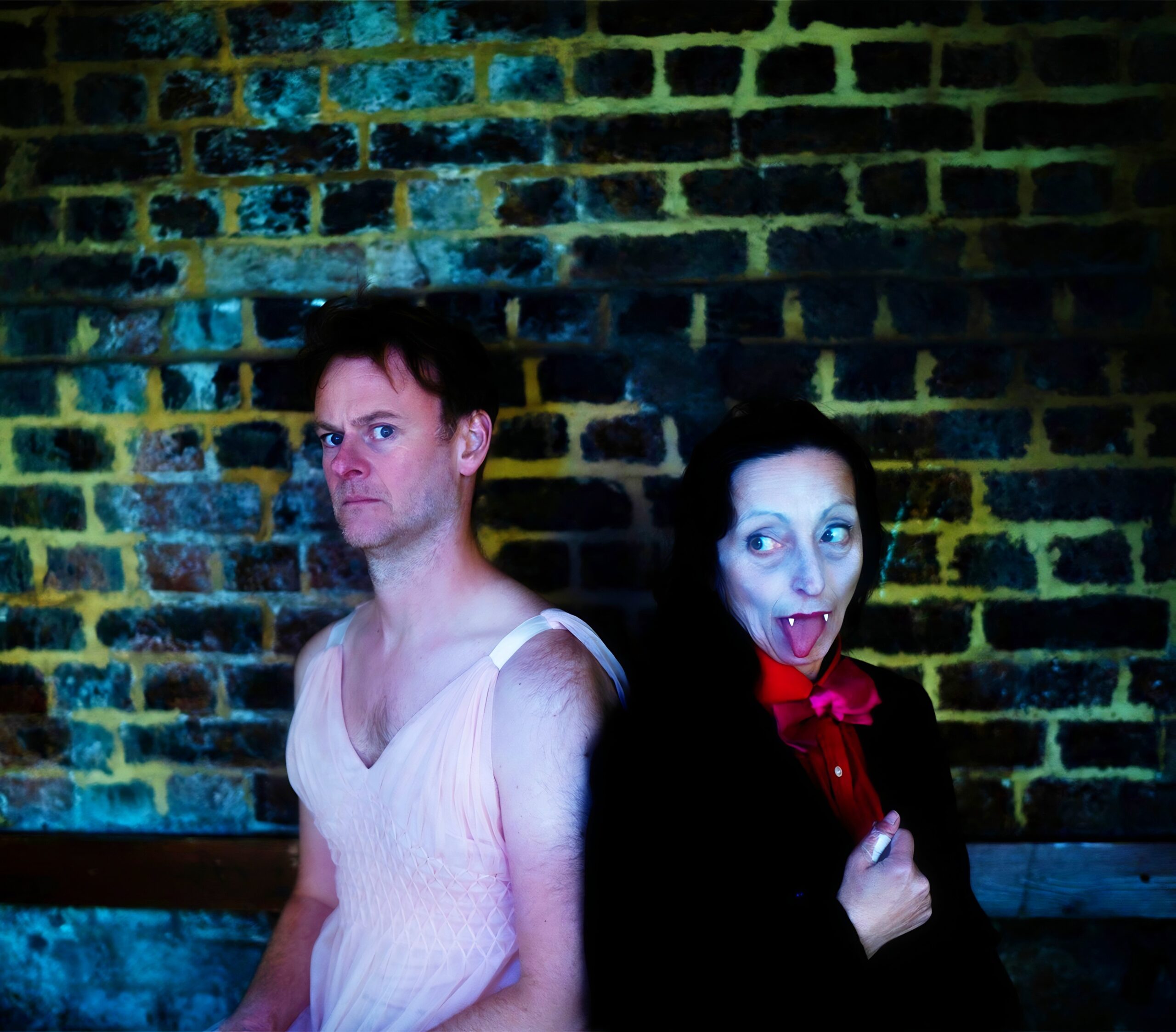
The theatre is small, and quaint, but I love that. Its not loud. Its not flashy. The actors are clowns at heart. The humour is so on the nose, that at first I don’t get it. Why are you given a garlic clove when you come in? Why has a baby doll’s head been bitten off? But then I fall in love, revelling in the gender politics, absurd surrealism and even improvisation. The themes are ones we are all familuar with. The demonfication of women, portrayed as female montrositity. The infantilization of older women. The stereotypes around women’s menstrual health. Except Countess Dracula turns those concepts on its head. The play begins in a hush. Red-crimson splattered lights. A velvet table, and a man and women in black and white seperates. Smiling, as though they know something that we don’t. Joanna Holden (Cirque du Soleil) steps on stage, and the energy shifts. Magnificient, terrifying and a whole lot of funny, I feel owned in that moment. Though on a smaller scale, it reminded me of the immersive storytelling of Punchdrunk, back in 2022.
Countess Dracula & Exploration Of The Vampire Body
Society often portrays vampires as men. Dracula ( inspired by Vlad The Impaler),Lestat de Lioncourt from Anne Rice’s The Vampire Chronicles and Lord Ruthven ( The Vampiyre 1819) are all prime examples. The men are often grotesque yes ( at least in early 19th century literature). Yet, they are ‘revered’ as characters, seen as strong, powerful and mighty. The women? Often hypersexualised for the sake of male gaze. Not here, although Countess Dracula isn’t a real vampire, the female character is the protagonist. Jack Kelly, as brilliant as he is plays second fiddle. That’s the point of course. Joey, or Countess Dracula gives a performance that is part confessional, part exorcism. Her every gesture feels deliberate: the tug of a glove, the flutter of a wing, the pause before a laugh. The Countess is monstrous not because she feeds on others, but because she dares to exist in a body the world no longer deems desirable. Jack Kelly, dosen’t skimp on performance either. Playing her husband, doctor and even her mum (yes!), his characterization is no mean feat.

Yet, surprisingly so, it is as an accessory to the ‘female vampire’. The person who only plays one role as Joey/ Mrs Robinson. Who as his wife, has the upper hand. Who as the patient visiting the doctor, has the last laugh. It is only when speaking to ‘her mum’, that she plays a secondary, listening role. But stay with me a minute. I want to go back to vampire folklore. The vampire’s body has always been seen as a battleground. A metaphor for trangression if you will. A body that doesn’t age, that resists control, that feeds on what society forbids. But here, the monster’s body isn’t a fantasy. It’s a menopausal one: real, sweaty, fluctuating, alive. Countess Dracula cleverly fuses the language of horror with the language of womanhood, making the audience question which of the two is truly more frightening. I like to see it as a feminist reimagining straight out of Julia Kristeva’s notion of the abject: the body that bleeds, ages, leaks — that can no longer be neatly contained or sanitised. The show makes that body sacred again. When the Countess dips her hands into sand that slips through her fingers like time itself, it’s both grotesque and beautiful — a small rebellion against disappearance.
Reclaiming ‘The Monstorous Feminine”
I spoke earlier about how vampires were often portrayed as men. Yet, there are an alarming number of female monsters. Witches, vampires, harpies, sirens and Medusas were cultural warnings. Representing male anxieties about women’s power, such as their reproductive capabilities, and perceived destructive potential. In Countess Dracula you can see this through the lens of the doctor, who makes repeated references to her age and ‘bodily norms’. About the way her ‘genitals look’ which is ‘to be expected for a woman of her age’. Using passive agressive and patronising language towards her. This alludes to how society would demonize ‘non-normative women’ whose ‘behaviour is seen as ‘abhorrent’.
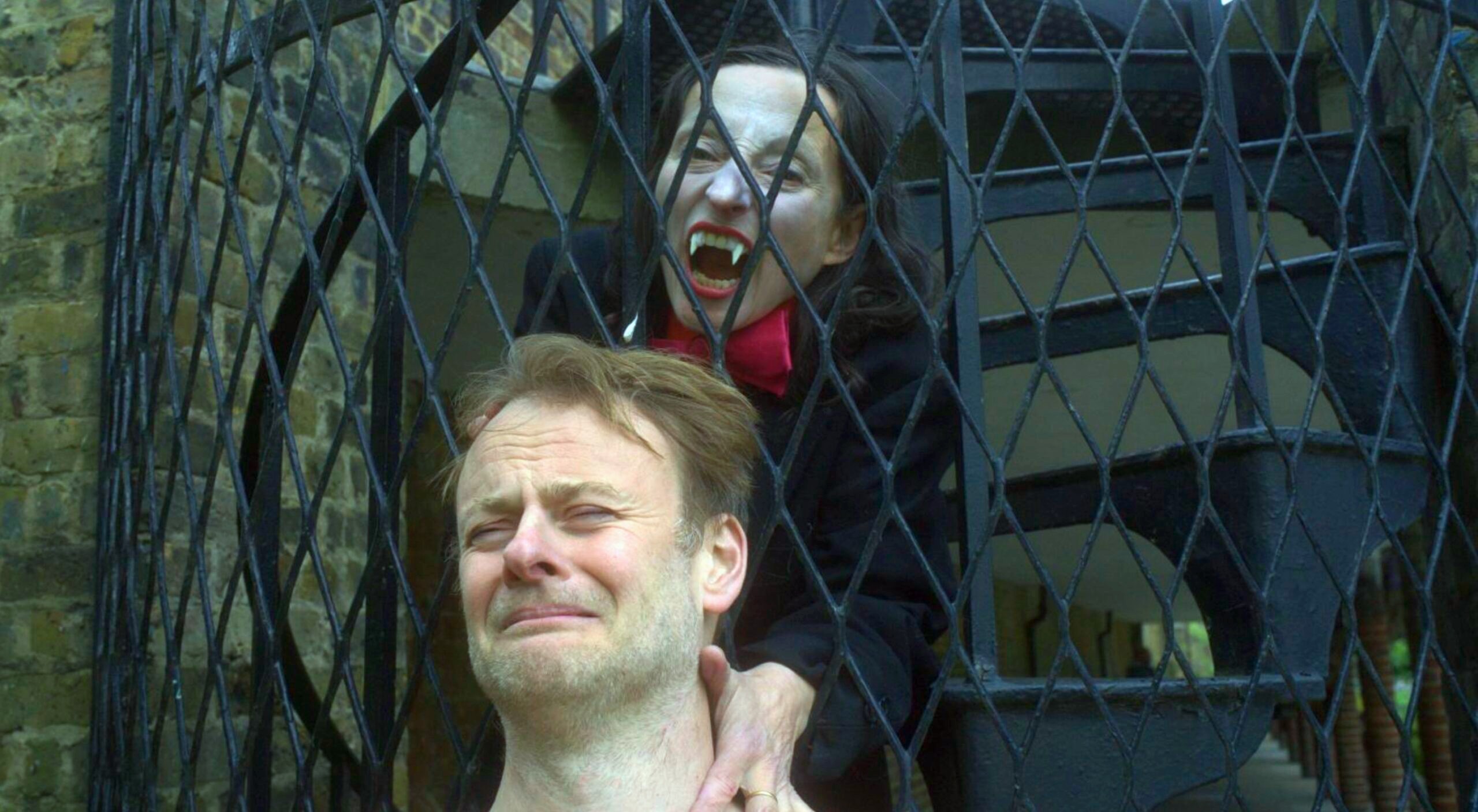
Barbara Creed’s The Monstrous Femnine, argued that horror films have long used female bodies as sites of both fascination and fear: the mother, the witch, the seductress, the crone. Countess Dracula takes that lineage and laughs in its face.Here, the Countess is all of those things at once — mother, lover, crone, beast — and the play doesn’t ask the audience to pick a side. It invites us to sit in that discomfort, to recognise how “monstrous” often just means “uncontrollable.” When she bares her teeth, it’s not a threat — it’s liberation.
In one particularly striking moment, the Countess declares, “I am what happens when you stop calling me beautiful.” It’s both thesis and curse. The theatre falls silent, and in that stillness, you can feel the collective ache of invisibility — the slow erasure that comes when society stops looking your way. It’s the kind of line that could have come from Simone de Beauvoir herself: the woman as “Other,” doomed to reflection rather than self-definition, until she writes herself back into being.
Countess Dracula’s Absurdist Comedy Tropes
On the surface level, the play might not make sense. You see the actors challenging boundaries, that you struggle to understand. The plot is linear, but isn’t at the same time. Some of the play is improvised and seem rather random. At times the plot drags, and you end up wondering what was the point of this scene. The dinner scene between Joey and Jack rings a bell. Setting the table, un-setting the table. Putting down food that never gets eaten. A whole song and dance that seems a little forced. Yet the show is lively and inventive. Some critics might find the slapstick humour off-putting. But I think the play is supposed to be silly. I mean what could be more fun than a woman masquerading as a vampire to highlight the trials of Menopause?

Once I found my groove, I started understanding what it was about. It was a comedy with teeth. That had dark undertones, but only if you looked for it. I would have loved to see more exploration of the menopause and society’s attitudes towards it, but I was pleased. It was funny, humour rooted in the absurd rituals of self-maintenance. The hot flushes that that arrive like jump scares, the endless performance of femininity. One minute Holden is parodying classic gothic tropes; the next, she’s performing a mock skincare ad mid-meltdown.
It’s the feminism of laughter — the kind Hélène Cixous might have recognised as écriture féminine: writing (or in this case, performing) the body back into language. The Countess’s jokes, her grotesque little dances, her mockery of male heroes — all become tools of reclamation. There’s an especially brilliant sequence where she invites the audience to “stake” her, but then undercuts the ritual with an eye-roll: “You’ve been doing that for centuries. Try something original.” It’s sharp, knowing, and far more political than it pretends to be.For a small touring show, the production values of Countess Dracula are pretty impressive, leaning into the enjoyable Victoriana with a mini curtained theatre which is repurposed as a tablecloth and later a vertical bedspread, and lots of attention to detail. The sideshow setting is well realised, while the writing style for these scenes draws on the hyperbole of the era, full of daring, mystery and an atmosphere of fearful wonder as the gathered audience is invoked to look inside the shadowy cage for the creature within. So, the fullness with which this world has been realised, as well as the cut-outs to a seaside location with Joanna’s no-nonsense mother, are really enjoyable.

Victoriana Era Production & Staging
Sometimes the only thing a play needs is a few props, and some good lighting. Countess Dracula is one of those. There’s a red velvet mini curtained theatre, that is repurposed over and over again. A tablecloth? AA vertical bedspread? Who would have thought. There’s a chair, that Jack AKA Joey’s mum frequents with monologues from beyond the grave. And who could forget that poor doll baby from Act 1, whose head got ceromonioulsy ripped off. Looking back, I think it was a metaphor for not being ‘able to have children’, with the last blood. But at the time, I was confused. However, the sideshow setting is well realized. The writing style is strong, almost Victorian, and formal in nature. It is a hyperbole full of daring, mystery and fearful wonder. The shadowy cage in particular was a triumph, Joey emerging with protruding fangs. Red blood dripping down her chin. Considering how small the theatre was, the space was full and rich. I loved the cut outs to the seaside location, where Joanna’s no-nonsense mother gave ghostly advice.
Countess Dracula Pros And Cons
Pros
- A fearless feminist concept. The play reclaims horror as a site of female power rather than punishment.
- An extraordinary lead performance. Joanna Holden’s Countess is funny, tragic, and terrifying in equal measure.
- Inventive use of physical theatre. Every movement and prop has symbolic charge.
- Rich with theory without becoming pretentious. You can feel the ghosts of Kristeva, Cixous, and Creed, but they dance rather than lecture

@phillipbouette
Cons:
- At times, the pacing wobbles — some scenes linger too long in abstraction. The dinner scene is an example of this.
- The symbolism, while potent, occasionally risks repetition.
- Those looking for a clear narrative arc may find the structure too dreamlike.
- A few moments of audience interaction could be bolder — the play flirts with chaos but never fully lets go.
Verdict
Countess Dracula is a spell — a feminist invocation disguised as gothic comedy. It’s not a show that politely makes its case; it bares its teeth, claws at expectation, and dares you to look away.
This isn’t about vampires. It’s about women who refuse to die quietly. It’s about the body as protest, the laugh as weapon, the horror of ageing turned inside out until it gleams.

Rating: ★★★★½ (4.5 out of 5)
For its wit, its guts, and its glorious refusal to disappear.
Show Information
Venue: Camden People’s Theatre, London
Created by: OftheJackel
Performed by: Joanna Holden (Countess) and Jack Kelly (ensemble)
Running time: Approx. 60 minutes
Genre: Gothic comedy / feminist physical theatre
Themes: Ageing, menopause, visibility, monstrous femininity, identity
Mood: Equal parts horror, cabaret, and ritual
Perfect for: Fans of The Love Witch, Fleabag, and feminist performance art with bite.
Running from 29th October-1st November

@phillipbouette
Are You A Fan Of Feminist Gothic Horror Shows?
*Disclaimer
Please note I was invited to review Countess Dracula but all thoughts are my own and are not affected by gifted tickets.


Leave a Reply